Changes to the Australian Standard – AS4084 2023
The Australian Standard for Steel Storage Racking has been updated for 2023. The standard is now in 2 parts; Design 4084.1:2023 and Operations 4084.2:2023. This update introduces a number of…
SWL charts define the maximum safe working load in three categories:
Bay. The overall load limit between a pair of frames
Shelf. The load limit for a pair of beams.
Unit. The load limit for the specific item being stored, such as a pallet.
Each category needs its own data. A system can fail at any one of these points, even if the others are well within limits.
The requirement to clearly communicate SWL information is written into AS4084 – the Australian standard for steel storage racking. Here’s what it means in practice.
Load limits must be known and understood. The working load limit per unit and per bay must be clearly shown on the system at all times and not exceeded.
Racking can’t be altered without a review. Adding, altering, removing components or changing racking usage all affect how load travels through the system. Any configuration change needs to be assessed before it is made.
A Safe Working Load chart is the clearest way to display load limits. Every racking system needs a corrosion-resistant plaque fixed at around two metres above floor level. The data displayed depends on the date of installation, but it must generally show (at a minimum):
A racking inspection tells you whether racking is damaged or compliant right now. Load capacity tells you what the racking is actually rated to carry. IRIA produce reliable Safe Working Load chart reports and can even print your SWL charts at our in-house facility.
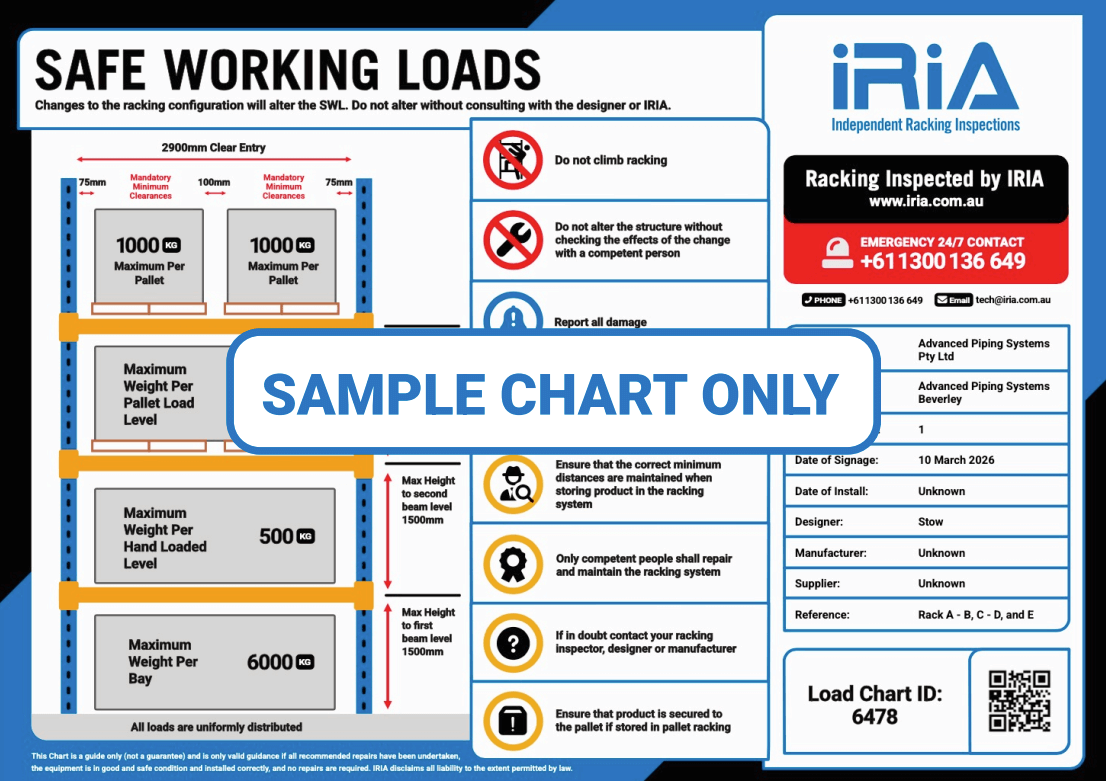
Even moving a beam to a different level can change how much a bay can safely carry. If your racking has been reconfigured and you’re not sure whether the original load chart still applies, it’s better to check with IRIA before something goes wrong – not after.
IRIA tests racking components and full systems at its dedicated facility in Melbourne. Beam tests, upright tests, frame tests – all conducted on purpose-built equipment and certified to AS4084 or other applicable standards on request.
We also maintain a database of previously tested components. That means your SWL chart is grounded in real test data from the actual parts in your system, not assumptions. And if your racking is older, no longer supported, or imported without documentation, there’s a good chance IRIA already holds the data you need.
The Australian Standard for Steel Storage Racking has been updated for 2023. The standard is now in 2 parts; Design 4084.1:2023 and Operations 4084.2:2023. This update introduces a number of…
When is a steel storage racking inspection not a racking inspection? Recently we have noticed an upturn in companies and individuals offering steel storage racking inspections. They fall into roughly…
An SWL chart tells everyone on site how much weight your racking can safely handle – at unit, shelf, and bay level. If you have steel storage racking, this is the easiest and best way to display SWL limits. It’s a requirement under AS4084, the Australian racking standard, not something you can opt out of.
Without an SWL chart, there’s nothing on the racking to show your team what it’s rated to hold, so they’re left relying on habit or guesswork. And if a workplace inspector visits and can’t find a chart on site, an improvement notice is the likely outcome. It’s one of the easier compliance gaps to close – and one of the more costly ones to ignore.
Yes! In most cases, we can supply replacement charts for selective racking – but we won’t know until after your inspection. It will depend on the amount of damage and/or if there are any major compliance issues. This is one of the most common reasons clients come to IRIA.